Mini Split Installation in Wichita, KS
A new system here will heat from October through April and cool from May through September every year. Tell us about the house, and a licensed contractor who covers Sedgwick County will get in touch.
Tell us about the job
It takes about a minute.
What a mini-split in Wichita has to handle
Your mini-split needs to heat from October through April and cool from May through September. That is every month of the year working. Winter nights average 24°F, so the heat pump side has to keep pulling warmth out of cold air for that whole stretch. Summer afternoons average 90°F, and the compressor runs against that heat for five straight months.
Any mini-split installed new has to meet the federal minimum for a split-system heat pump, 14.3 SEER2 for cooling and 7.5 HSPF2 for heating. Sedgwick County also sees its share of ice and wind, with 11 winter storms and 332 damaging wind events recorded over the last ten years. A mini-split mounted outside needs to be set and secured with that in mind.
- 7 months
- October through April, your system heats
- 5 months
- May through September, it cools
- 24°F
- the average winter night it heats against
- 90°F
- the average summer afternoon it cools against
NOAA nClimDiv, 1991–2020 normals
In Kansas, HVAC licensing for homes is left to the counties and cities.
Sedgwick County sets its own rule for this job, since Kansas leaves HVAC licensing to the counties and cities rather than handling it at the state level. There is no state exam behind the work and no state record of who is doing it. Whatever protection exists here comes from what Sedgwick County or the city where the house sits has set up on its own.
For a mini-split installation, the piece that applies almost everywhere is the permit. Most cities and counties require a permit for this kind of installation and send someone from the building office to inspect the work once it is done. That inspection is the check on whether the unit was installed correctly, since no state license is standing behind it here.
Source: Kansas Office of Revisor of Statutes
- Is a mini split worth it?
- For the right setup, yes. A mini split cools in summer and heats in winter without ductwork, so it works well for additions, garages, or older homes with rooms that never got vents. Winter lows here average 24°F, so look for a model rated for cold climates so it keeps up on the coldest nights. A contractor can look at the space and tell you whether it fits what you need.
- How many rooms can a mini split cover?
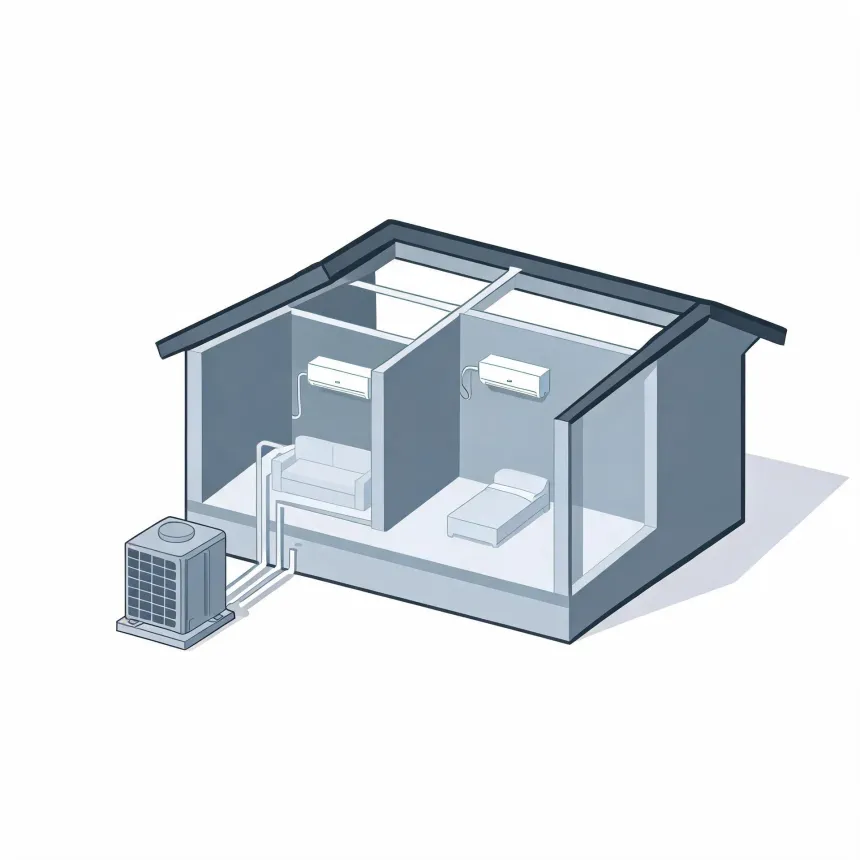
- A single outdoor unit can run one indoor head or several, depending on the system. Single-zone systems handle one room. Multi-zone systems run several indoor heads off one outdoor unit, each with its own thermostat. The right count comes down to the size of the rooms and how the outdoor unit is sized, which is why a contractor needs to look at the house before recommending a setup.
- Can a mini split heat a whole house?
- It can, if it is sized and placed for that job from the start. A multi-zone system with an indoor head in each main room can heat the whole house, and cold-climate models are built to keep working through winter lows like the 24°F nights here from December through February. Homes here need heat October through April, so the system has to be sized for that full stretch, not just mild weather. That sizing work is what a contractor does when they look at the house.