Mini Split Installation in Hutchinson, KS
A new system here will heat from October through April and cool from May through September every year. Tell us about the house, and a licensed contractor who covers Reno County will get in touch.
Tell us about the job
It takes about a minute.
What a mini-split here has to handle
Reno County asks for heat seven months a year, October through April, and cooling the other five. That is almost the whole year with a mini-split running one mode or the other. Winter nights average 23°F, cold enough that the heat pump side has to work to keep up. Summer afternoons average 90°F on the cooling side.
Any new mini-split has to clear the federal minimum for split-system heat pumps. That is 14.3 SEER2 for cooling and 7.5 HSPF2 for heating. Every unit sold today meets that floor. This area also sees its share of winter storms and damaging wind, and a fifth of Kansas households lost power for at least a day in 2024. Worth asking how the system you choose handles an outage, especially if it is replacing a furnace that runs on gas.
- 7 months
- October through April, your system heats
- 5 months
- May through September, it cools
- 23°F
- the average winter night it heats against
- 90°F
- the average summer afternoon it cools against
NOAA nClimDiv, 1991–2020 normals
In Kansas, HVAC licensing for homes is left to the counties and cities.
Kansas has no state license for HVAC contractors. That leaves it to Reno County and the cities in it to decide what a contractor needs before working in a home, so the rule here depends on the address rather than anything the state tracks.
For a mini-split installation, what applies in most Kansas cities and counties is the permit process. The local building office issues the permit and sends someone to inspect the work once it's done. With no state license behind the job, that inspection is what checks the installation was done right.
Source: Kansas Office of Revisor of Statutes
- Is a mini split worth it?
- For the right house, yes. A mini split heats and cools without ductwork, so it works well in additions, garages, or homes where running ducts isn't practical. Here winters drop to 23°F on average and summers reach 90°F, and a mini-split heat pump built after 2023 has to meet 7.5 HSPF2 for heating and 14.3 SEER2 for cooling, so it's built to handle both seasons. Whether it's worth it for your house depends on the layout and what you're heating or cooling now, and a contractor can walk through that with you.
- How many rooms can a mini split cover?
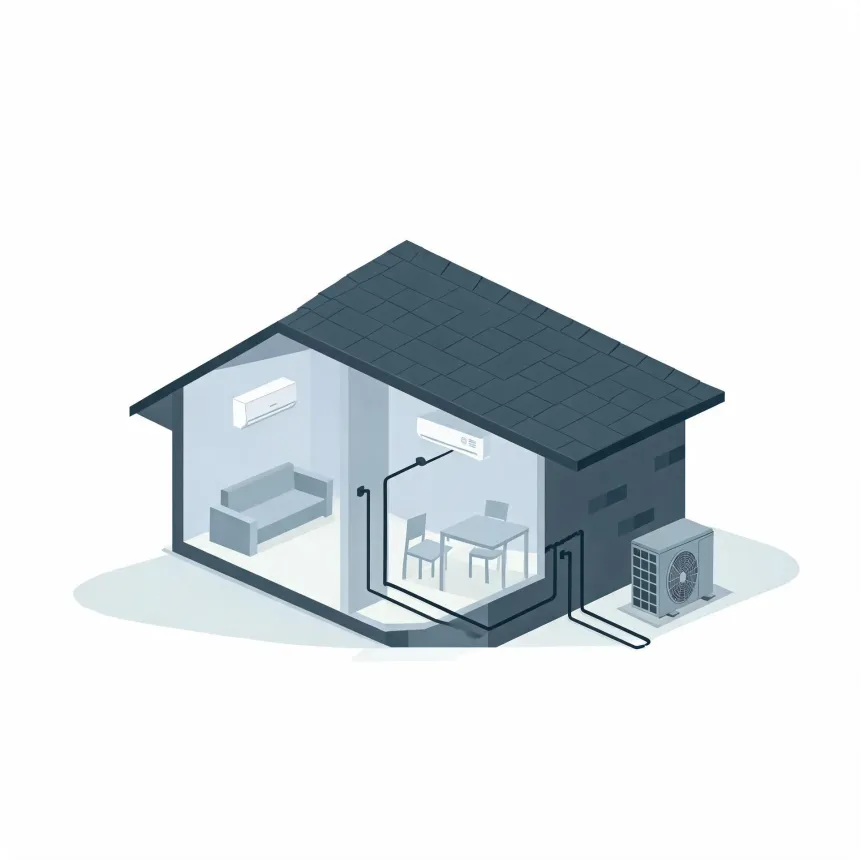
- A single indoor unit is sized for one room or one open area. If you need to cover several rooms, a multi-zone system connects two or more indoor units to a single outdoor condenser, each zone controlled on its own. How many zones a house can support depends on the outdoor unit's capacity and the layout of the rooms, so a contractor should size it room by room rather than guess at a number.
- Can a mini split heat a whole house?
- It can, if the system is sized and placed for every room that needs heat. A multi-zone mini split puts one indoor unit in each area, and together they can carry the whole house through a winter where nights average 23°F from December through February. Whether that makes sense for your home instead of a central system depends on the layout and how the house is built, so it's worth having a contractor look at the whole place before deciding.