
Is duct cleaning worth it in Lawrence, KS

Request a pro

You're trying to figure out if duct cleaning actually does anything, or if it's a service that mostly gets sold on fear. That's a fair question before you spend money on it. Douglas County summers run long and muggy, and winters get plenty cold, so your system runs hard most of the year either way. Whether cleaning your ducts makes sense depends on things specific to your house: what's been found in the ducts, how the system's been maintained, whether anyone in the house has allergies that flare up. A local contractor who deals with ducts and furnaces all over this area, in homes built every which way, can look at yours and tell you straight whether it's worth doing now or whether your money's better spent elsewhere. Answer a few questions about your house and you'll be matched with one contractor local to Lawrence, not a handful competing for your callback. They'll reach out and walk through what they're seeing in systems like yours.

For most homes in Lawrence, duct cleaning is worth doing when there's a reason for it, not on a fixed schedule. Dust and pet hair build up in ducts over time, and if you can see it coming out of the vents or settling fast on furniture, that's a sign your system is stirring up more than it should. Long muggy summers push your air conditioner to run for hours at a stretch, and that constant airflow moves whatever is sitting in the ducts through the whole house. Cold winters do the same with the furnace. If anyone in the house has allergies or asthma, clearing that buildup can make a real difference in what you're breathing. But if your ducts look clean and nobody's noticed dust or odors, cleaning them on a whim won't improve anything. The honest answer is it depends on what's actually in your ducts right now, and a straightforward inspection tells you that for less than a cleaning costs.

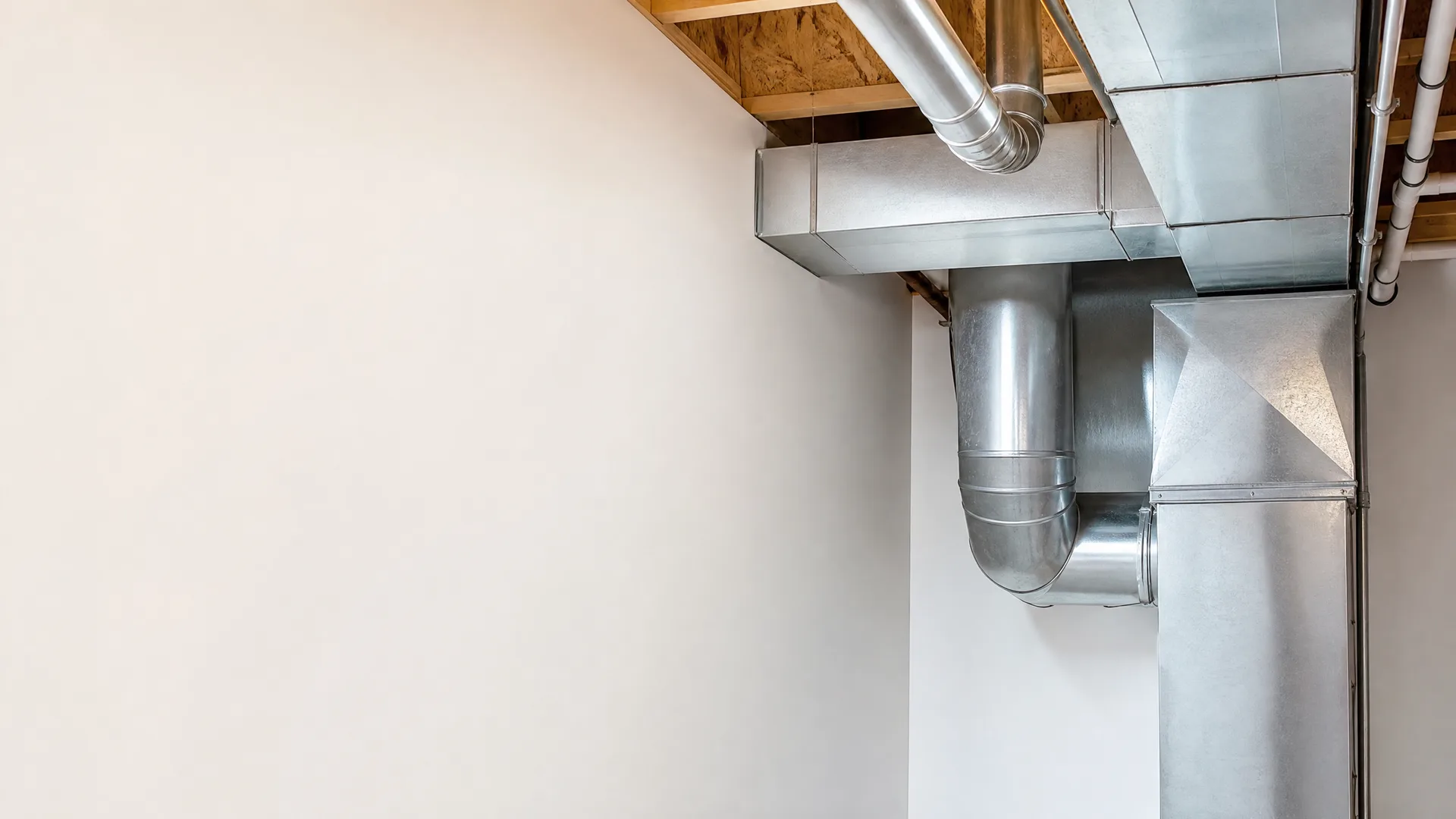
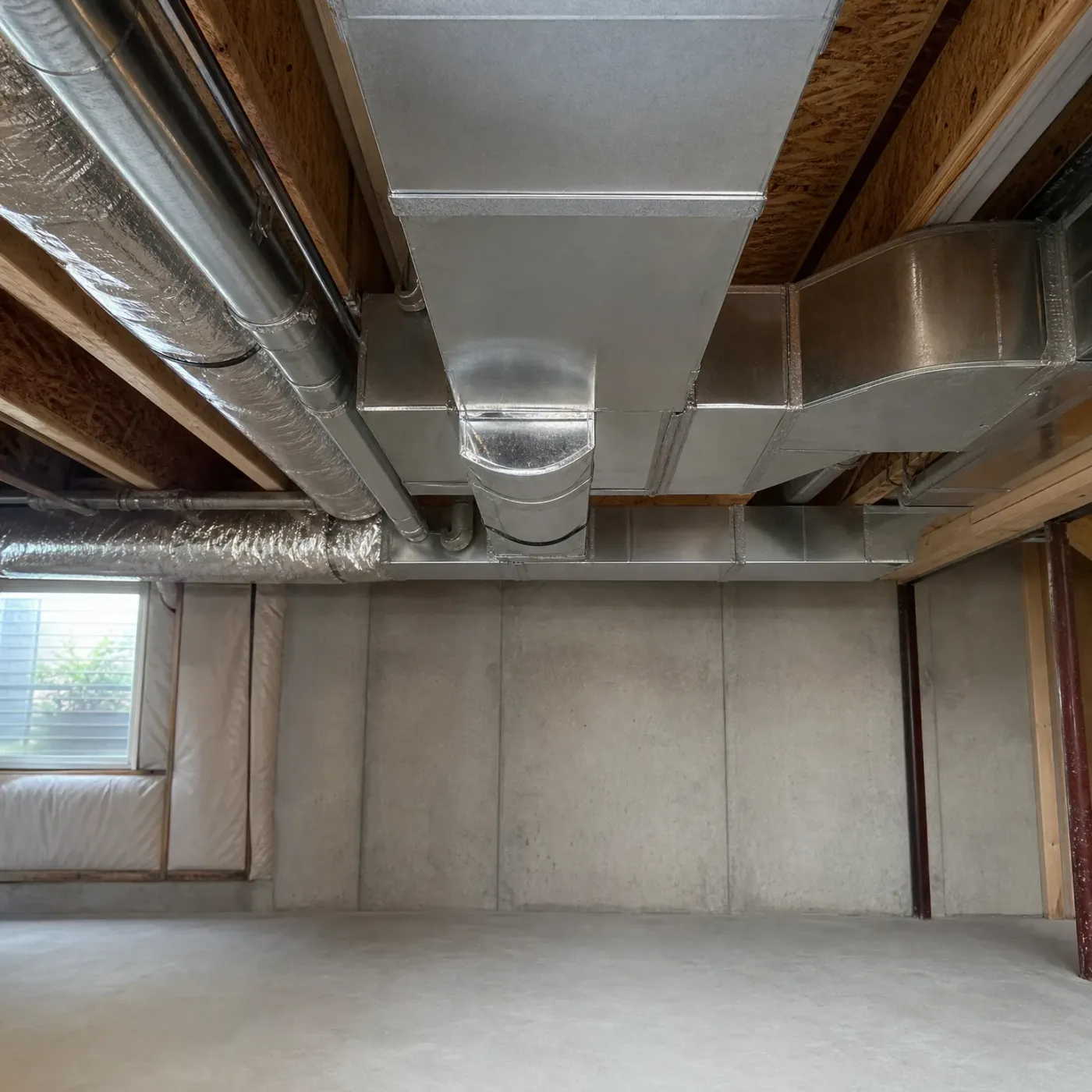
Galvanized sheet-metal ductwork and pipes running along an unfinished basement ceiling beside a plain beige wall, with a gray equipment cabinet below.

What actually sits in your ducts

Dust in a duct is mostly skin cells, fabric fibers, and whatever dirt tracks in off your shoes. It builds slowly along the bottom of the trunk lines where airflow is weakest. A little of it is normal in any house. What matters is whether it's loose enough to blow back out through the registers, or packed down enough to cut the air your furnace or AC is pushing through the house.

Galvanized sheet metal rectangular and round HVAC ducts running along a ceiling and down a white interior wall, with exposed wood joists and subfloor above.

Why some homes need it sooner

A house with a dog or cat sheds more into the return air than one without, and that hair mats against the filter and the duct walls faster. A recent remodel leaves drywall dust that a filter alone won't catch in time. If your system came with the house, nobody can tell you what's built up inside it over the years, which is exactly why a look inside the ducts tells you more than a guess does.

How much does your duct system actually run each year?

  • Half the homes here were built by 1988

    Half the homes in Douglas County were built in 1988 or earlier. Older ductwork has had more years to collect dust and more chances for a loose joint or a gap in the seal.

  • Heat runs October through April

    Heat runs October through April here, about seven months. That's seven months of air moving through the same ducts, carrying whatever has settled in them toward every room.

  • Cooling runs May through September

    Cooling runs May through September, about five months. Combined with heat, your ducts move air nearly year round, which is worth knowing before you decide cleaning them is overkill.

ACS 2020-2024 · NOAA nClimDiv 1991-2020

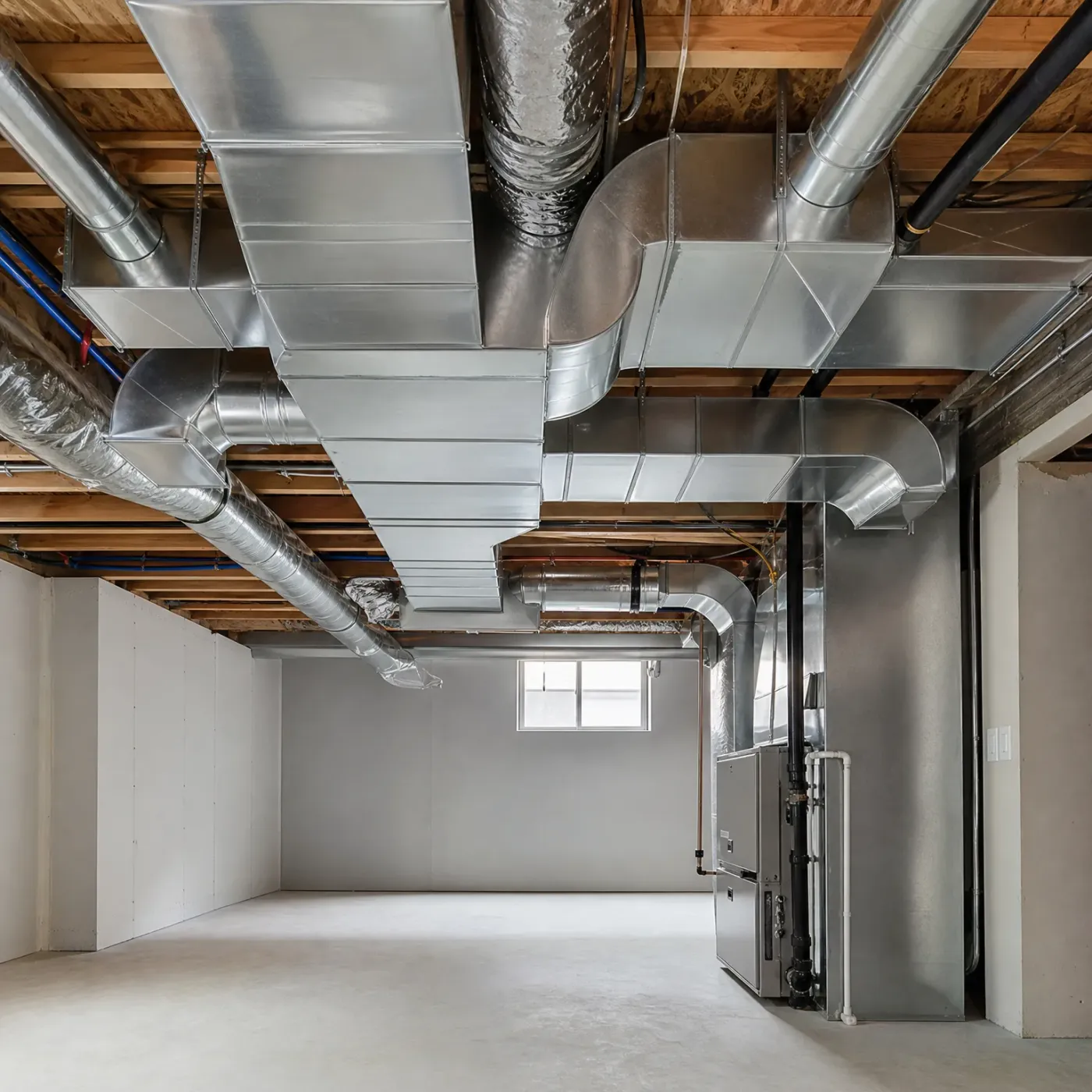
Empty unfinished basement with bare concrete walls and floor, showing galvanized sheet metal ductwork, insulated flexible duct, and pipes running along the wood-framed ceiling, with a small window at left.

Ducts that are doing their job

This is what sealed, intact ductwork looks like running through a basement. The joints are tight, the metal is solid, and air moves through without leaking into the joists above. A system like this can go a long time without needing anything more than a filter change.
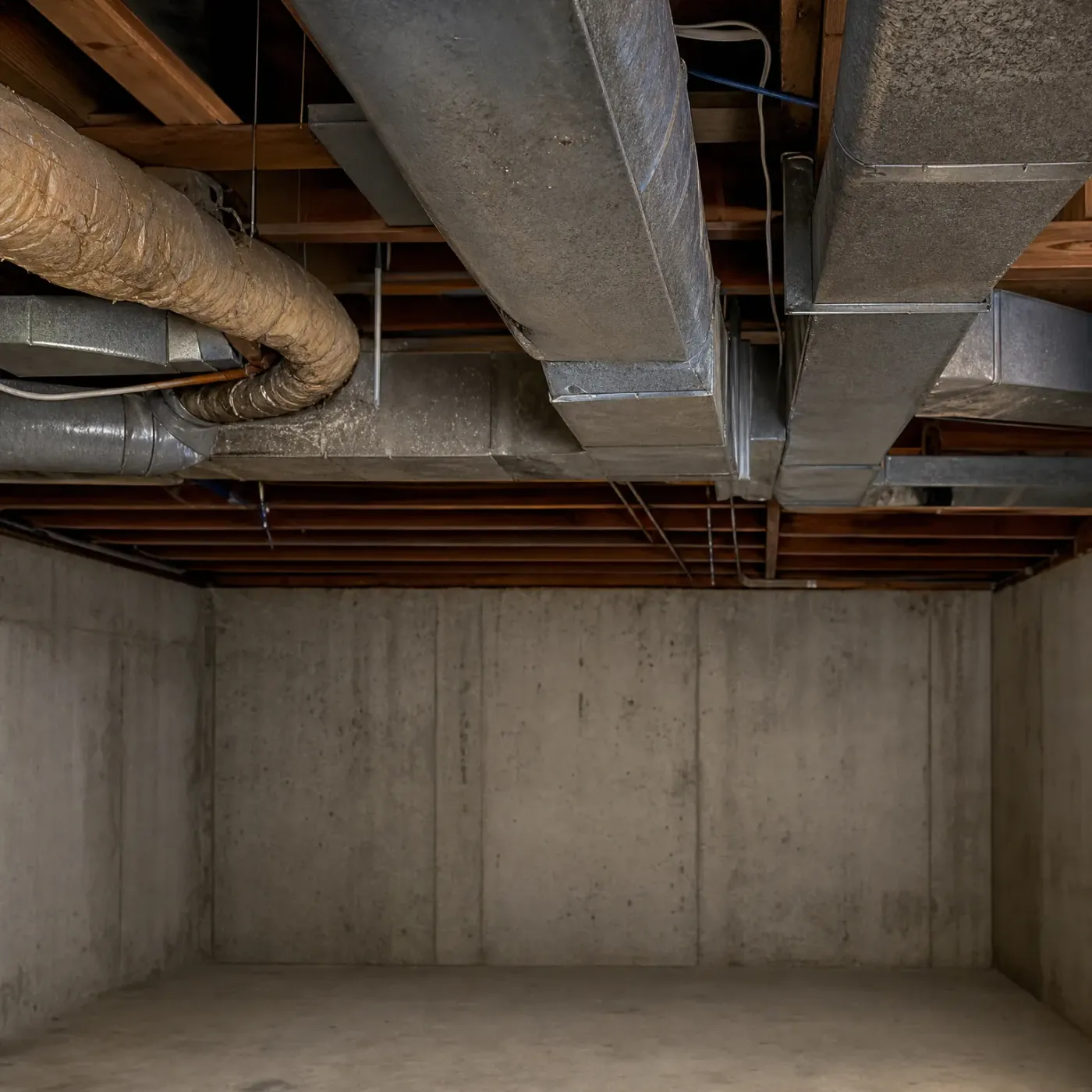

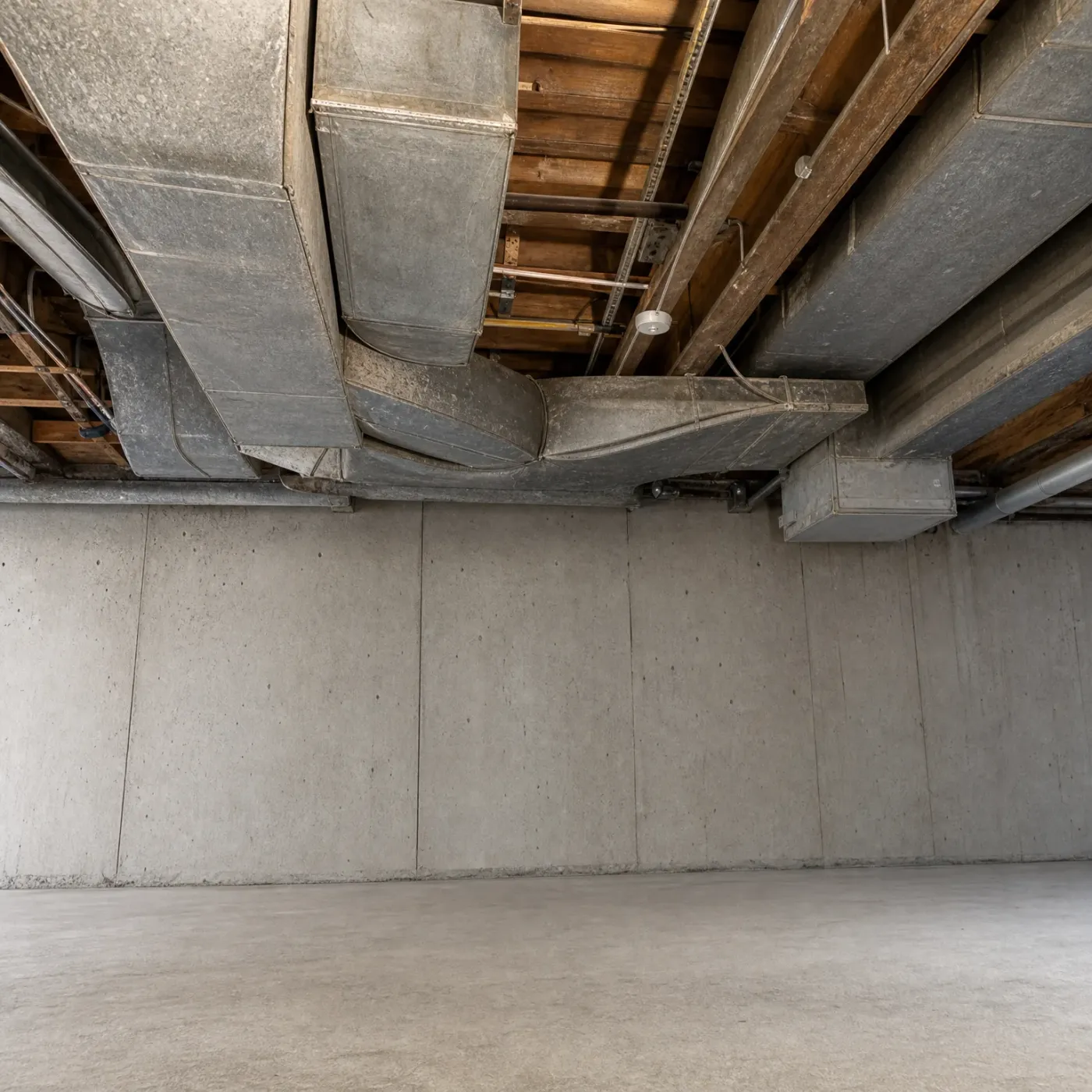
Empty basement room with bare concrete walls and floor, with exposed wooden joists, sheet-metal HVAC ducts, an insulated flexible duct, and pipes running across the ceiling.

Ducts that need a look

Flex duct sagging against joists, seams that were never sealed well, wiring crowding the metal. Gaps here let dust in and conditioned air out before it reaches your vents. If your ductwork looks like this, cleaning alone won't fix what's wrong with it.

How does a duct cleaning actually get done?

You want to know what actually happens when someone cleans your ducts, not just that it gets done. Maybe you're picturing someone running a vacuum hose down a vent for twenty minutes, and you want to know if that's really all there is to it, or if there's a real process behind it that justifies having it done at all.

A negative air machine pulls dust out while agitation tools knock it loose

A contractor connects a vacuum collection unit to your duct system first, so the whole system runs under negative pressure before anything gets disturbed. Then a brush or an air whip goes into each duct run and knocks the dust off the walls of the duct. That loosened dust gets pulled toward the vacuum unit instead of blowing out into your rooms. Every supply and return vent gets opened and cleaned this way, one at a time, along with the trunk lines that feed them. The furnace blower compartment and coil usually get a pass too, since dust collects there as much as anywhere in the system. Done right, it's a sealed process, not a room full of dust by the time it's finished.

A dimly lit interior wall with a ceiling air vent above a wooden sideboard holding a potted plant, a shallow bowl, and a table lamp beside a curtained window.

It's a Saturday afternoon in April, sun coming through the living room window, and you finally notice the ceiling vent above the couch. The grille has a gray ring of dust around every slat, thick enough to see from across the room. You run a finger along the bookshelf underneath it and it comes back dark. You dusted that shelf a week ago. The furnace hasn't run in days, just the occasional blast of air when the thermostat kicks on, and every time it does a little more settles on the same spot. You stand there looking at it, not sure if this is normal or not.

Unfinished basement with exposed wood joists, galvanized sheet-metal ductwork, insulated flex ducts, piping, a small window, and a furnace or air handler against a gray wall.
Steel trunk lines and flex duct run clean through this basement, tied into the furnace with no sign of gaps or staining at the joints.
Empty basement room with bare concrete walls and floor, and an exposed ceiling of wooden joists with large galvanized sheet-metal ductwork and pipes.
Here the ducts run through open floor joists where dust has settled thick along the seams and sheet metal seams are visible with age.
A gray-haired man in a dark coat with snow on the shoulders and collar stands smiling in a dimly lit entryway with a paneled front door, lamps, and a framed picture in an adjoining room.
A gray-haired, bearded man in a dark winter coat with snow on the shoulders stands in a doorway of a home interior with a lit lamp, framed pictures, a potted plant and a staircase behind him, and an evergreen wreath at the left edge.
An older man with gray hair and a beard, wearing a snow-dusted dark coat and knit scarf, stands smiling in a dimly lit house entry with a lit lamp, mirror, and a living room with snow visible through the window behind him.
A smiling gray-haired man in a dark wool coat with snow flecks stands in a dimly lit home entryway, with a lit table lamp, potted plant, framed pictures and a living room visible behind him.

Matched to your ductwork job

If you've looked at your vents and you're pretty sure the dust is real and not just a reason to spend money, the next move is having someone look at the actual ducts, not a photo of someone else's. A contractor who works on duct systems around Lawrence every year has seen what Douglas County basements and crawlspaces tend to do to sheet metal and flex duct over time, and can tell you in person whether what's collecting in yours is cosmetic or something worth clearing out. You get matched with one local contractor for this, not a handful competing for your callback. They'll look at your actual runs, your actual vents, and tell you what they find. If the answer is that it can wait, that's a fair answer too. Either way you'll know, instead of guessing from a vent cover.

When cleaning is worth the money

If you can see dust blowing out of the vents, if someone in the house has started sneezing more at home than away from it, or if you just finished a renovation that filled the house with drywall dust, cleaning the ducts makes sense. Rodents or insects getting into the ductwork is another clear reason, since what they leave behind doesn't come out on its own. In these cases the dust or debris is doing something, either getting breathed in or sitting heavy enough to notice. A contractor who cleans ducts for a living can tell you within a few minutes of looking whether what's in your system matches one of these situations or not.

When it's probably not worth it

If your ducts look normal, nobody in the house has new or worsening allergy symptoms, and you're just doing it because it's been a few years, the case is weaker. A light, even layer of dust along the bottom of a trunk line is normal in any house and doesn't mean much on its own. Cleaning ductwork that's already working fine doesn't fix a duct that's leaking air into the joists or a seam that's come loose, and it won't lower your gas or electric bill by itself. If what you're really dealing with is a leaky duct or a furnace that's working harder than it should, that's a different problem with a different fix.

A woman wrapped in a thick gray fleece blanket sits in an armchair with an open book on her lap, beside a lit lamp and a window covered in frost patterns at night.
A woman in a cream knit sweater sits in a light upholstered armchair with her eyes closed and a slight smile, beside a window showing orange autumn foliage, with a bookshelf, lamp, and a mug on a side table nearby.

Ducts with no visible dust, no new pets, no recent work done on the house

If the vents look clean and nothing's changed in the house, cleaning won't fix a problem that isn't there. Spend the money when there's a reason, not before.

Find a licensed ductwork pro

Gray rings on the vents, more sneezing indoors, or a renovation that filled the house with drywall dust

These are signs worth acting on. A contractor who works on ducts around Lawrence can look at what's actually in yours and tell you if cleaning will help.

Find a licensed ductwork pro
Unfinished basement with bare concrete walls and floor, and galvanized sheet-metal HVAC ducts, pipes and wiring running along the wood-joist ceiling.
Before you get your ductwork cleaning
Unfinished basement with concrete walls and floor, a steel beam on posts, and exposed wooden joists with sheet-metal ductwork and piping overhead.
After you get your ductwork cleaning

Power here costs 14.77 cents per kilowatt-hour

At that rate, a leaky duct run that's pushing heated or cooled air into the attic or crawlspace instead of your living room shows up on the bill every month. Sealed ducts mean your furnace and AC aren't paying to condition air nobody uses.

EIA-861 2025

So, is it worth it

  • Duct cleaning in Lawrence is worth it when there's visible dust, a new pet, recent construction, or a sign something's actually wrong, not on a set schedule.
  • Sealed, intact ductwork can run for years without needing to be cleaned at all.
  • A local contractor who works on duct systems around Douglas County every season knows which signs point to a real problem and which don't.
  • Getting matched means one contractor looking at your specific ducts, not a sales pitch built around a fixed service plan.
  • If your vents look clean and nothing's changed in the house, the honest answer is to wait and save the money.

The answer comes down to what's actually happening in your house, not the calendar. Gray dust around the vent slats, a new dog shedding into the return, a remodel that left drywall dust behind, those are reasons to get the ducts looked at. A quiet system with clean vents and nothing new going on in the house isn't one. Douglas County homes vary a lot in how their ductwork was built and sealed, which is exactly why a fixed schedule doesn't make sense here. What makes sense is someone who can look at your actual trunk lines and joints and tell you whether what they find is normal buildup or something that's actually costing you money through a leak or a real dust problem. That's the kind of judgment that comes from working on duct systems around this area every season, through the same long summers and hard winters your system runs through, and seeing which problems repeat and which ones don't. When you get matched, it's one contractor, not several competing for the job, which means someone looking at your ducts on their own merits instead of trying to close a sale before the next lead comes in. If your vents are clean and nothing's changed, the straight answer is to hold off. If they're not, you already know it, and now you know who to ask.

Galvanized sheet metal HVAC ductwork with a white vent grille, mounted against wooden floor joists in a dim basement with concrete block walls.

Get matched with a duct system pro in Douglas County

Duct and vent cleaningDucts or ventsDouglas County, KS
Step 1 of 2

What ZIP code is the job in?