Profile view of a bearded man wearing a black baseball cap and a dark gray T-shirt against a plain light background.

Why your furnace rattles in Kansas

RepairFurnace or heatingKansas
Step 1 of 2

What ZIP code is the job in?

A rattle usually means something inside the furnace has worked loose. The blower wheel can have a screw back out over time, or the panels on the cabinet shake against each other once the blower kicks on. Cracked heat exchangers also rattle, and that one is not safe to ignore, since it can let exhaust leak into your air. Gas furnaces here run for months at a stretch once the cold sets in, and all those hours of vibration are what loosen things that were tight in October. A loose duct connection right off the furnace can rattle too, especially where it was never sealed well to begin with. Some of these are a five-minute fix, tightening a panel or a screw. Others, like a cracked exchanger, mean the furnace needs to come apart and get looked at properly before you run it again.

A smiling woman with dark shoulder-length hair in a cream V-neck sweater sits at a marble counter with a glass of red wine, with a kitchen and softly lit living room behind her.
A woman in a dark green sweater laughs while seated at a marble kitchen island with a glass of red wine, with open shelving, cabinets and a living room visible behind her.
A woman with long dark hair in a cream knit sweater laughs while looking off to the side, seated at a counter with a glass of red wine, in a dimly lit living room with a sofa, lamp, framed pictures and houseplant behind her.
A smiling woman with long dark hair in a beige sweater sits at a marble kitchen counter with a glass of red wine, with a dimly lit living room behind her.

Is this just a loose panel, or something worse?

Most nights it's the same spot in the cycle. The furnace kicks on, runs quiet for a minute, then starts rattling once the blower reaches full speed. You might hear it most from a bedroom near the furnace closet or the basement stairs. Sometimes it's a metallic buzz that comes and goes with the blower speed. Sometimes it's a steady clatter that doesn't let up until the burner shuts off. A loose panel usually rattles the whole time the blower runs. A wheel with a backed-out screw tends to get louder over a few weeks, not overnight. If the rattle comes with a burnt or metallic smell, or the furnace shuts itself off mid-cycle, that points to something past worn hardware and worth having looked at before it runs again.

A dim unfinished basement with concrete walls, exposed floor joists, a small window, and a furnace connected to metal ductwork and PVC venting.

You're down in the basement around seven, putting the folding table away, and the furnace is off. It ran twenty minutes ago, you heard the rattle again, same as every night this week. Now it just sits there, dark, quiet. A little dust hangs in the air near the cabinet where the blower is, caught in the light from the bare bulb overhead. Outside it's already dark, mid-November cold settling into the house. You crouch down and put a hand near the access panel, like you might feel something, then you don't. You straighten up, leave the light on a second longer than you need to, and head back upstairs.


Winter nights average 23°F statewide

At 23°F, your furnace is running long cycles most nights to keep up, and that's more hours for a loose screw or panel to keep knocking. A rattle that was easy to ignore in October gets harder to live with once the burners are running half the night.

NOAA nClimDiv 1991-2020 county normals weighted by homes

Where the rattle actually starts

  • The blower wheel sits on a shaft held by a set screw, and that screw backs out from vibration over months of running.
  • A loose wheel knocks against the housing in a steady rhythm that speeds up and slows down with the blower itself.
  • Sheet metal cabinet panels have a few screws each, and one working loose lets the whole panel buzz against the frame.
  • The heat exchanger is a thin metal chamber that expands when it heats up and contracts when the burners shut off, and a crack there changes that normal tick into a harsher rattle.
  • Return air ductwork connects to the cabinet with screws or clips, and those can loosen the same way panel screws do.
  • A technician opens the cabinet, runs the furnace, and touches each panel and the blower assembly to find exactly where the sound starts.

Most of what you hear traces back to a handful of spots inside the cabinet. The blower wheel rides on a shaft, and a set screw holds it in place. Months of running loosens that screw a little at a time, and once it backs out far enough, the wheel shifts and starts hitting the housing on every rotation. That knock speeds up as the blower ramps up and slows down as it winds down, which is why the sound seems to change through the cycle. The cabinet itself is sheet metal held together with a handful of screws per panel. One screw working loose is enough to let that whole panel buzz against the frame once the blower moves air past it. The return duct connects to the cabinet the same way, with screws or clips, and those loosen for the same reason panel screws do. A crack in the heat exchanger is a different problem. That chamber is thin metal that expands when the burners fire and contracts when they shut off, and that movement makes a quiet ticking sound on its own. A crack changes the shape of that metal just enough that the tick turns into something sharper and harder to miss. None of these look alike once someone's inside the cabinet. A technician runs the furnace with the panels off, listens, and touches each panel and the blower assembly in turn until the sound stops or gets louder under a hand. That's how the spot gets found instead of guessed at.

A smiling bearded man in a navy sweater sits at a candlelit dinner table with a glass of red wine, a bowl of salad, and plates of food in the foreground.
A woman with dark hair in a bun reclines on a sofa with her eyes closed, wrapped in a cream fleece blanket, a closed blue hardcover book resting in front of her, with a lit lamp and a vase of dried flowers in the background.
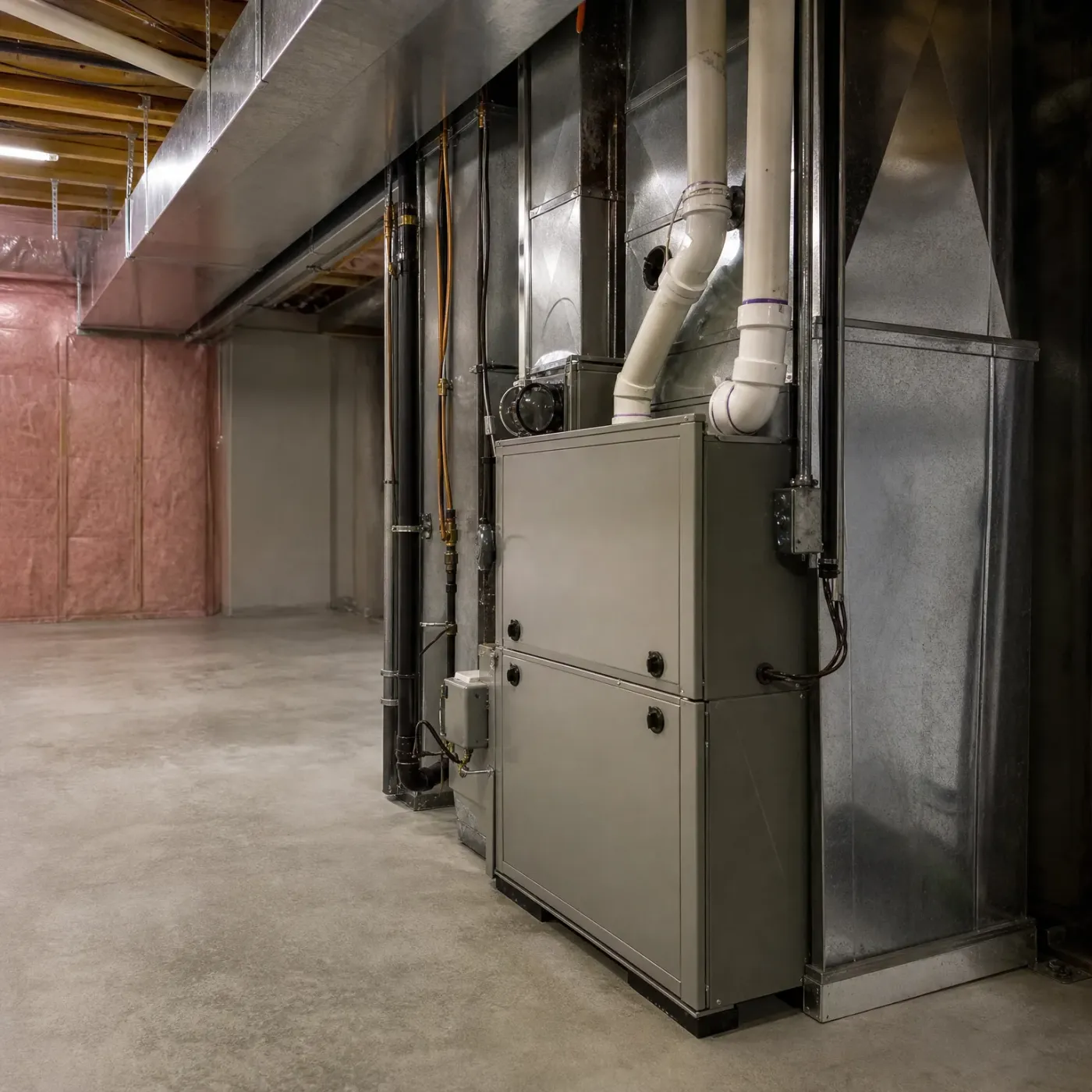
An unfinished basement with a concrete floor, pink insulation on one wall, exposed joists, galvanized sheet-metal ductwork, PVC vent pipes, and a tall gray furnace with attached gas and electrical lines.

A local pro for your furnace repair

Answer a few questions instead of calling shop after shop.

Say what's going on with your furnace, and a pro who works on them reaches out.

Find a furnace pro

Sending the form costs nothing.

A beige furnace with a louvered front panel and metal ductwork stands on a concrete basement floor beside pipes and a white cylindrical water heater.
Before you get your furnace repair
A gray high-efficiency furnace in a basement with PVC venting pipes, a yellow gas line, metal ductwork, concrete walls and floor, and a wood-framed stairway at left.
After you get your furnace repair
  1. Gas valve opens and the igniter glows hot enough to light it.

  2. Burners light and heat the air moving through the heat exchanger.

  3. Blower motor spins up and pushes that warm air into the ducts.

  4. A loose screw or panel starts knocking as the blower hits full speed.

A gray high-efficiency furnace stands on a concrete basement floor beside galvanized sheet-metal ductwork, with white PVC vent pipes, gas and water lines, and unfinished wood framing behind it.
A furnace running the way it should moves warm air through the ducts without a rattle, bang, or metallic knock from the cabinet.
A beige furnace with two louvered front panels stands on a concrete basement floor beside galvanized ductwork, metal pipes, and a wooden post.
Once a screw backs out or a panel shakes loose, that same furnace knocks every time the blower hits full speed, all winter.

Why does my furnace only rattle when the blower kicks into high speed?

You've noticed the rattle isn't there the whole time the furnace runs. It stays quiet during ignition, then starts up once the blower really gets moving. That pattern isn't random, and it points to where the loose part actually is, rather than somewhere else in the cabinet.

High speed shakes loose parts harder, so that's when you hear them

Your blower motor runs at a lower speed first, then ramps up once the furnace calls for full heat. A screw or panel that's just slightly loose won't make much noise at low speed because there isn't enough vibration to move it. At full speed, the blower wheel spins fast enough that any play in a screw or any gap between panels gets shaken hard, and that's the knock you hear. If the rattle only shows up at high speed, the loose part is most likely tied to the blower assembly itself or a panel closest to it, not something near the burners or gas valve, which run the same regardless of blower speed.

A gray high-efficiency furnace in a basement with white PVC vent pipes, sheet-metal ductwork, copper and black piping, a condensate pump, and insulated walls above a concrete floor.

The sound of a furnace running right

Air moves through the ducts, the burners hum, and the cabinet stays quiet. No knock when the blower ramps up, no metal-on-metal tap. Every panel sits flush and every screw holds the blower wheel exactly where it belongs on the shaft.

A beige residential furnace stands on a concrete basement floor beside galvanized sheet-metal ductwork, a round flue pipe, copper gas piping, and a PVC condensate line, with a wood-paneled wall at right.

The sound of one that's worked something loose

That flue rising to the chimney, those older panels with a little grime on them, that's a furnace that's been running for years without anyone checking what's come loose inside. A rattle like this usually means a part has shifted, and it won't tighten itself back up.

A man seen from behind raises his hand to wave at a woman standing in the open front doorway of a single-story house with gray shingle siding, white columns and a gabled porch entry.

A rattle has a cause, and it doesn't fix itself

A loose screw or a shaking panel stays loose until someone gets inside the cabinet and finds it. Nothing about a Kansas winter makes that happen on its own. The furnace will keep cycling on the same schedule, the blower will keep hitting full speed, and the knock will keep showing up right where it always has, night after night, until the burners go quiet for the season.

Finding out which one it is means someone who knows furnaces looking at yours, not guessing from a description. You don't have to spend evenings calling around Kansas for someone who can get out to look at it, explaining the rattle again on every call, then sitting with a stack of quotes trying to figure out which one makes sense. A contractor matched to your furnace and what you've described reaches out to you directly, and you go from there.

A gray upholstered sofa with a textured cushion sits beside a dark round side table holding a vase of green foliage, with a table lamp and sheer-curtained window behind.
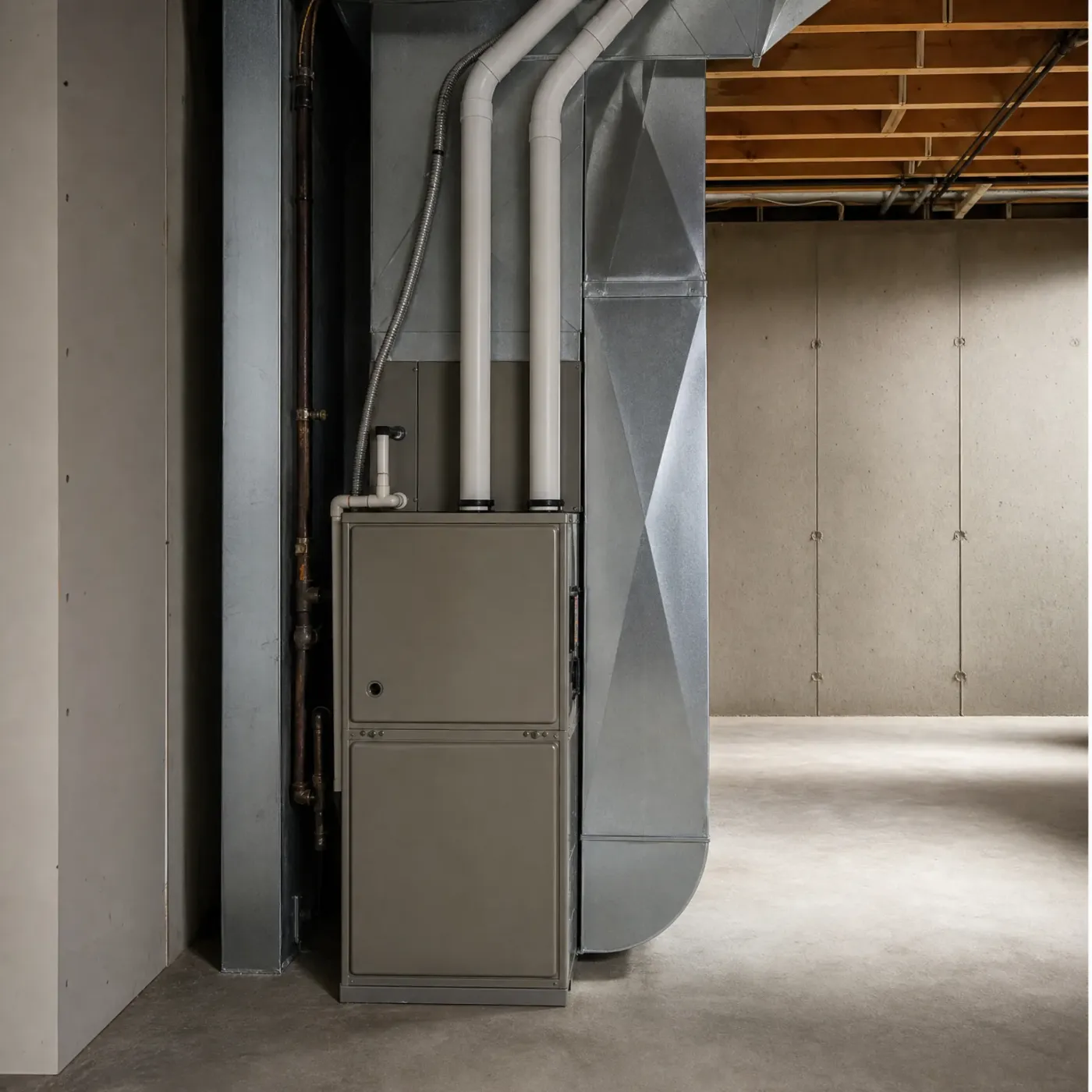
A gray high-efficiency furnace in an unfinished basement, connected to sheet-metal ductwork and two white PVC vent pipes, with copper piping and exposed wood floor joists nearby.

Get the right pro for your furnace

Get a local pro

Describe your furnace job once, to one pro.

You're not committing to anything by asking.