Mini Split Installation in Leavenworth, KS
A new system here will heat from October through April and cool from May through September every year. Tell us about the house, and a licensed contractor who covers Leavenworth County will get in touch.
Tell us about the job
It takes about a minute.
What a mini-split in Leavenworth County has to work with
Your mini-split runs all twelve months here. Heat is needed October through April, seven months, and cooling May through September, five months, so the outdoor unit gets no real season off.
Winter nights average 23°F, cold enough that the heat pump has to work for every degree it moves indoors. Summer afternoons average 87°F on the other end. Any mini-split installed new has to meet 14.3 SEER2 for cooling and 7.5 HSPF2 for heating, the federal minimum for split-system heat pumps since 2023, so it is built to handle both ends of that range. The last ten years brought 7 winter storms and 92 damaging wind events to the area, and storms like that can knock out power. A mini-split comes back on by itself once power returns, but it will not heat or cool the house while the outage lasts.
- 7 months
- October through April, your system heats
- 5 months
- May through September, it cools
- 23°F
- the average winter night it heats against
- 87°F
- the average summer afternoon it cools against
NOAA nClimDiv, 1991–2020 normals
In Kansas, HVAC licensing for homes is left to the counties and cities.
Leavenworth County sets its own rule for HVAC contractors, and Kansas does not step in with a state license behind it. Whether a contractor is licensed at all depends on whether the county or the city where the house sits requires one. There is no statewide list or exam to point to here, only whatever the local government has put in place.
For a mini-split installation, the protection that applies comes from the permit process instead. Most cities and counties require a permit before the work starts and an inspection once it is done, and that inspection is what catches a bad line set connection or an install that was not done to code. That inspection is not a license and does not test the contractor. It checks the work itself, after it is done.
Source: Kansas Office of Revisor of Statutes
- Is a mini split worth it?
- For the right house, yes. A mini split heats and cools without ducts, so it works well for additions, garages, or a room that never gets comfortable off the main system. Most homes here heat with gas, so a mini split usually adds comfort to specific rooms rather than replacing the furnace. Whether one unit or several makes sense for your house is something a contractor will look at room by room.
- How many rooms can a mini split cover?
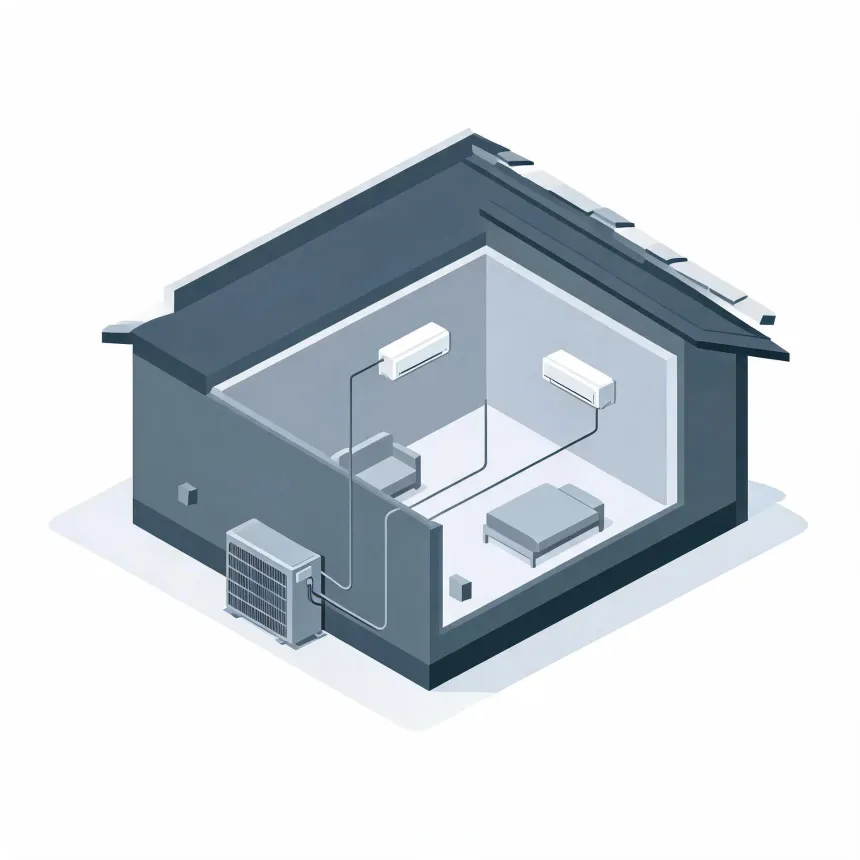
- One outdoor unit can run one indoor head or several, depending on the system. A single-zone system heats and cools one room or open area. A multi-zone system runs several indoor heads off one outdoor compressor, with each head controlled on its own. How many rooms one outdoor unit can carry depends on the size of the rooms and the capacity of the system, so a contractor will size it to the house rather than guess a number in advance.
- Can a mini split heat a whole house?
- It can, but it depends on the layout. A house with an open floor plan can sometimes be covered by a multi-zone system with a head in each main area. A house with a lot of separate rooms and hallways is harder to cover fully, since each closed-off space needs its own head to get heat. Homes here need heat from October through April, so a contractor sizing the system will account for how cold it gets on the worst nights, not just an average day.