Mini Split Installation in Garden City, KS
A new system here will heat from October through April and cool from June through September every year. Tell us about the house, and a licensed contractor who covers Finney County will get in touch.
Tell us about the job
It takes about a minute.
What Garden City winters and summers ask of a mini-split
Winter nights here average 20°F from December through February. Summer afternoons run near 91°F. Homes need heat from October through April and cooling from June through September, so a mini-split works 11 months out of the year with only a short break in spring and fall.
Any new mini-split has to meet the federal minimum for a split-system heat pump, 14.3 SEER2 for cooling and 7.5 HSPF2 for heating. That standard applies whether the unit is ducted or ductless. With cooling season and heating season together covering nearly the whole year here, that efficiency floor is doing real work most months, not just on the hottest or coldest days.
- 7 months
- October through April, your system heats
- 4 months
- June through September, it cools
- 20°F
- the average winter night it heats against
- 91°F
- the average summer afternoon it cools against
NOAA nClimDiv, 1991–2020 normals
In Kansas, HVAC licensing for homes is left to the counties and cities.
Finney County sets its own rule on who can do this work, since Kansas leaves HVAC licensing to the cities and counties instead of running a state license. That means there is no state exam and no state record to check here. Whatever standard applies to the contractor comes from the local government, not from Topeka.
For a mini-split install, the protection here comes from the local building office rather than a license. Most cities and counties require a permit for this kind of installation and an inspection once the unit is in and running. That inspection is what confirms the work was done right, since there is no state license behind it to answer for it.
Source: Kansas Office of Revisor of Statutes
- Is a mini split worth it?
- For most homes, yes, especially for a room your main system does not reach well. Garden City needs heat seven months a year and cooling four months, so a mini split earns its keep working nearly all year in an add-on room, a garage conversion, or a house with no ductwork at all. It also gives you a second source of heat or cooling for that room if your main system ever goes down. Whether it makes sense for the whole house depends on how your home is set up now, and a contractor can walk through that with you.
- How many rooms can a mini split cover?
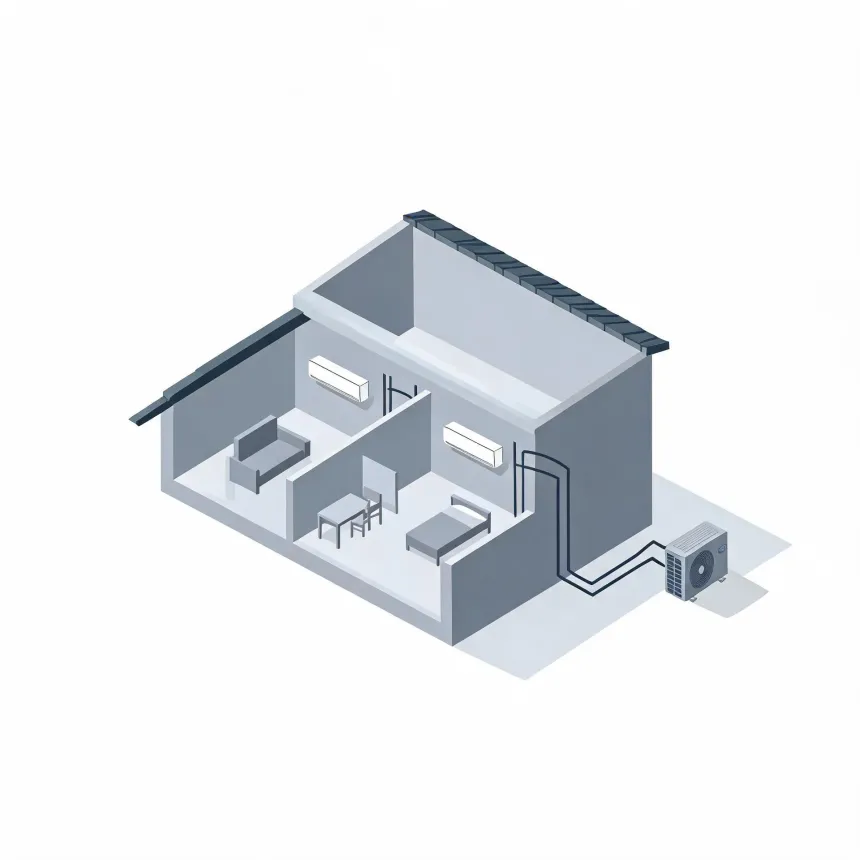
- A single outdoor unit can run one indoor head or several, depending on the system. Each indoor head is sized and placed to heat and cool the room it is in, so coverage comes down to how many heads you install and how big each room is. A contractor sizes the system room by room rather than guessing at a whole-house number.
- Can a mini split heat a whole house?
- It can, if enough indoor heads are installed to cover every room, but that takes planning room by room, not just one unit. Garden City winters get cold, down to a 20°F average low overnight from December through February, so the heat pump has to be sized to keep up on those nights. A contractor can lay out how many heads your house needs and whether a mini split alone makes sense or should work alongside your existing furnace.