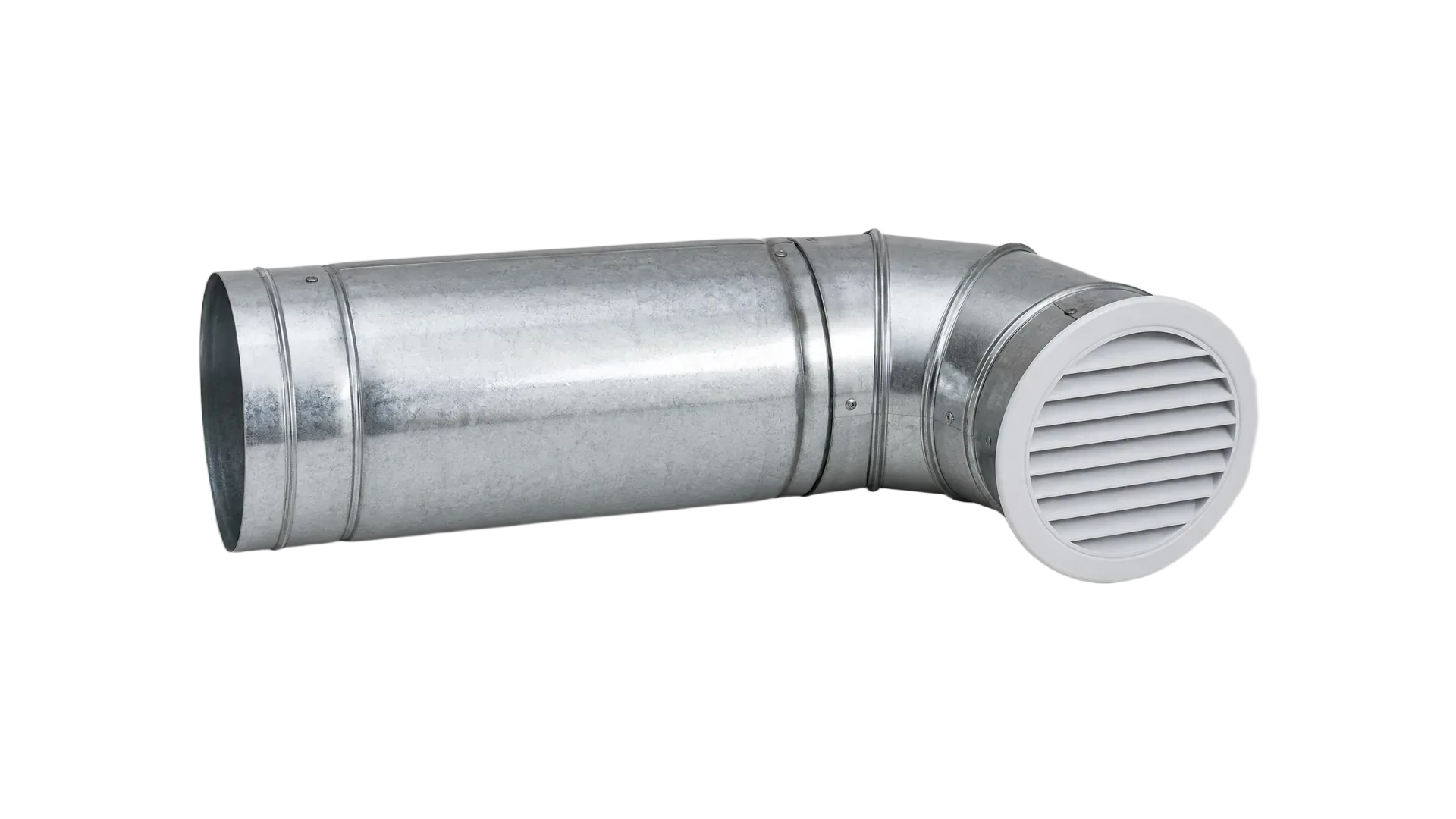

Clean duct run
This is what a duct run looks like with no moisture problem behind it. The metal stays bright, the joints stay dry, and air moves through without picking up dust or spores along the way. Nothing here is feeding mold.
A musty smell when the furnace or AC kicks on usually means mold somewhere in the ductwork, and in Wyandotte County that is almost always tied to moisture. Summers here run long and sticky, and the humidity that comes through the return air settles inside the ducts, especially anywhere the metal stays cool and damp. Mold needs that moisture to grow, and once it has a foothold on dust inside the duct, it spreads every time the blower runs. You might see dark specks around the vent covers, or just notice the smell gets stronger the longer the system runs. It will not clear up on its own, because the ducts stay dark and closed off, and each heating or cooling cycle pushes spores through the house rather than clearing them out. Cleaning the duct system and finding where the moisture is getting in is the only way to stop it. Left alone, it keeps building, and the air moving through your home carries more of it each season.


Your AC's evaporator coil runs cold so it can pull moisture out of the air. That water has to go somewhere, and most of it drips into the drain pan right at the start of the duct run. The rest clings to the duct walls nearby. That's why the musty smell hits hardest the moment the system kicks on, before the air moving through has a chance to dry things out. If your ducts leak at the seams, humid air from the attic or crawlspace gets pulled in and gives mold another way in, not just from the vents you see. Flexible duct makes this worse, since its ribbed liner holds dampness longer than a straight run of sheet metal would. Once mold takes hold in one stretch, the spores ride the airflow and seed the lining further down the line. A dirty filter slows that airflow down, and slower air gives moisture more time to settle before it ever reaches a room.




Cleaning removes the mold growing on the duct walls and in the register boxes, but it does not change the moisture that let it grow back there. If the humidity coming off the coil keeps condensing in the same spot, mold can return in the same few feet of duct within a season. A contractor who finds standing water in the drain pan or a slow drain line during the cleaning is looking at the actual source, not just the symptom. That is why what gets found during the job matters as much as the cleaning itself.
Sheet metal or flex duct, once cleaned, should be dry to the touch and free of any dark staining along the seams. Staining that returns within weeks points back to moisture rather than dust. A properly sealed duct run also stops pulling in the attic or crawlspace air that carries extra humidity into the system to begin with. Someone who works on furnaces and AC systems around Wyandotte County every summer has seen which duct runs tend to collect water and which register boxes trap it, and knows where to check first on a house like yours.
At just over 14 cents a kilowatt-hour, running the blower longer than it needs to doesn't cost much here. If mold has narrowed the airflow through your ducts, the fix isn't to push the fan harder. It's to get the growth out and stop the moisture feeding it.
EIA-861 2025
This is what a duct run looks like with no moisture problem behind it. The metal stays bright, the joints stay dry, and air moves through without picking up dust or spores along the way. Nothing here is feeding mold.

This is what months of trapped moisture leave behind. The dark coating on the metal is dust bound up with grime, and mold can live in it. Air moving through this duct picks up what's growing on the walls and carries it into your rooms.
Seeing mold in the ductwork makes a lot of homeowners assume the whole system has to come out. Replacing ductwork is a bigger job and a bigger expense than cleaning it, so before you plan for that, it helps to know what actually decides whether the ducts can be saved or whether they need to go.
Metal ductwork, which is what most houses in Wyandotte County have, holds up fine once the mold is cleaned out and the moisture problem behind it is fixed. The metal itself doesn't feed the mold, so there's nothing left behind once the growth is removed. Replacement comes up when the ducts are lined with fiberglass insulation board or flex duct, since mold can grow into those materials rather than just sit on the surface, and at that point cleaning can't reach it. A contractor who opens up a duct run can tell you which situation you're dealing with. Most of the time here, it's a cleaning job, not a teardown.




The pro who gets in touch is licensed in Kansas and works in Wyandotte County.
It costs nothing to send, and you don't have to hire anyone.
Every time the blower kicks on, air moves across whatever is growing in that duct run before it reaches your living room. Mold spores and the musty smell travel with it, into bedrooms and anywhere the supply registers open. If anyone in the house has asthma or allergies, that's what tends to flare first, especially through a long Wyandotte County summer when the system runs for hours at a stretch. The smell fades in and out, but the air moving past that growth doesn't stop just because you can't smell it that hour.
Mold doesn't stay put. It spreads along the metal wherever moisture keeps collecting, past the first few feet near the coil and into the runs feeding other rooms. The growth itself can narrow the duct and slow the air getting through, so rooms farther from the furnace or air handler end up with weaker airflow than they used to have. Left alone through another humid summer, the same wet spot keeps feeding the same growth, and what started in one section of ductwork doesn't stay confined to it.
Half the homes here were built by 1962
Heat runs October through April here, about seven months. That's seven months of a warm duct run sitting next to whatever moisture is already in there.
Heat runs October through April
Cooling runs May through September. That's five more months of the coil condensing humidity right where the duct work starts, feeding the same spot.
Cooling runs May through September
Half the homes in Wyandotte County were built in 1962 or earlier. Ductwork that old has had a long stretch of both seasons to let mold take hold.
ACS 2020-2024 · NOAA nClimDiv 1991-2020
The smell led back to moisture, and the moisture led back to a spot in the ductwork where it keeps collecting, usually near the coil. That's the whole problem. It isn't a sign the ductwork is bad or that the system needs to be torn out. It means something is growing where warm, damp air sits too long, and it needs to be cleaned out before it keeps spreading spores into the rooms you spend time in.
Getting that done right depends on whoever's doing it knowing what they're looking at. A duct run behaves differently in July than it does in January, and a contractor who services systems here through both knows that the trouble spot in a Wyandotte County home is rarely random. They've opened up runs like yours before, in houses that sit through the same long summers and the same hard winters, and they know where to check first and what it usually takes to stop the growth from coming back instead of just wiping out what's there now.
When you send a request through this page, it goes to one contractor, not a handful. That means no juggling calls from competing companies, no repeating your situation five times over. Just one licensed contractor, local to the area, looking at the actual problem in your actual ducts. From here, the next step is getting that set in motion.

Send one request and you're done looking